
Featuring:
?
Daddy Strongest did as he pleased, in phases. One particular phase involved ‘agricultural entrepreneurship’ (he announced importantly), but of course, Daddy Strongest being the ‘him’ that he is, always wanted to do things big and different- he went off and bought himself a tea garden[1], much to Mother Dearest’s horror, Sister Sweetest’s indifference and my absolute delight.
The tea garden was not very large in area but by no means small either- it lay a short distance away from the quaint little town in Assam that had our home. We visited the tea garden often- my eyes would light up in wonder every time we entered the gates and see the bed of green as far as one could see. I would ask Daddy Strongest “do we really belong to it”? Daddy Strongest would indulge me with a nod and a smile.
I quickly learnt the workings of a tea garden. I also very quickly learnt the many hidden quirks of this green, heavenly piece of paradise that I belonged to. There were, as expected, many a superstition surrounding the land and I was not to wander around alone (picture this- a waif of a child skipping along paths, followed by two heavyset women and four very large men!).
People of various religious faiths worked in the tea garden and as the ‘Burra Sahib’[2], Daddy Strongest had to partake in many a ritual of religious significance. These rituals were not without intrigue.
It was especially before the Second Flush[3], that the pace of religious activity turned frenetic. On a designated morning, Daddy Strongest, his family and the senior management of the tea garden had to pay obeisance before the Goddess Shakti deity placed in a temple at the entrance of the tea garden. And then the entire company would proceed to an old mosque (age unknown) some distance inside the tea garden.
School usually kept me away from the tea garden at this time of the year but this one particular year, I made it in time for what is about to follow! I had, of course, heard the stories countless times and was excited and impatient to experience it all. The pace at which the morning progressed seemed excruciatingly slow! We finished with the temple and proceeded towards the mosque in the large open ‘jeeps’, which was the norm de jure in tea gardens.
The mosque itself was a small structure, nearly in ruins. What however caught one’s attention were the two graves laid neatly side-by-side a little away from the front door of the mosque. No one knew who lay within the graves. Daddy Strongest had had the graves cleaned and a wall built around them.
The men went inside to offer prayers while the women set up a fire to cook Khichri[4]. The Khichri would first be offered at the graves before being had for lunch. Legend has it that the food offered at the graves would disappear without a single soul, man or beast, approaching, let alone touching the offerings! I, ofcourse, was agog with excitement and decided to keep a vigil to test the veracity of the legend.
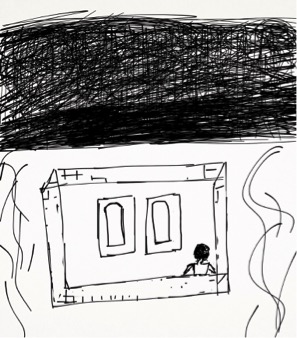
The men finished their prayers, the Khichri was ready. Mother Dearest and the other women neatly arranged the food on banana leaves and as was the tradition, placed a portion at the head of each grave, along with an earthen lamp and incense sticks with each portion. My playmate and I sat on the wall surrounding the grave watching the goings-on. We sat on the wall and we watched and we watched for what seemed like hours. Mother Dearest repeatedly called us for lunch but I refused to move away from the wall.
I heard rustling of footsteps behind me and froze. Oh well, it was only a furious Daddy Strongest coming across to yank me from my perch and drag me by the scruff of my neck to the mosque where Mother Dearest was tiredly waiting for me for lunch. My playmate ran away in fright.
I turned my head a fraction to tell Daddy Strongest I would leave in a moment and dejectedly turned back for one last look at the graves. The Khichri was gone. The banana leaves were wiped clean. The lamps and incense sticks burned brighter and stronger.
[1] Just another (but more commonly used) term for a tea estate.
[2] A salutation reserved for the person of most significance in a tea garden. I was Chota Baba, Sigh!
[3] Assam tea is generally harvested twice, in a “first flush” and a “second flush.” The first flush is picked during late March. The second flush, harvested later, is the more prized “tippy tea,” named thus for the gold tips that appear on the leaves. This second flush, tippy tea, is sweeter and more full-bodied and is generally considered superior to the first flush tea. The leaves of the Assam tea bush are dark green and glossy and fairly wide compared to those of the Chinese tea plant. The bush produces delicate white blossoms. Source: https://en.wikipedia.org.
[4] Khichdi, or khichri, is a South Asian preparation made from rice and lentils. Khichdi was the inspiration for the Anglo-Indian dish kedgeree, and is also commonly considered to be the inspiration for the popular Egyptian dish, kushari. Source: https://en.wikipedia.org.
 Sira, Doi Aru Gur